
Winning at esports takes more than quick reflexes. Mechanical skill matters, but it is only one part of competitive performance. Strong players also understand positioning, communication, preparation, resource management, and the mental side of competition. The hmcdgaming esports guide by harmonicode approaches competitive gaming from that broader perspective. Rather than treating improvement as a simple matter of playing more hours, the guide focuses on strategy, physical readiness, mental discipline, equipment, and the small decisions that can change a match.
That approach fits the way modern esports actually work.
A player may have excellent aim but still lose because of poor positioning. A mechanically gifted team can throw away an advantage through weak communication. One bad rotation can also turn a winning game into a losing one.
Harmonicode presents itself as a gaming-focused platform covering esports, video games, and retro gaming. Its content also explores tournaments, professional players, teams, strategies, and competitive gameplay.
This guide takes a closer look at the harmonicode gaming approach and explains how players can apply its ideas to real competitive situations.
Editorial note: HMCDGaming and Harmonicode publish the concepts discussed in this article. Performance-related recommendations should be viewed as practical guidance, not guarantees of competitive success.
What Is the HMCDGaming Esports Guide by Harmonicode?
The HMCDGaming esports guide is built around a straightforward principle: competitive performance has several moving parts.
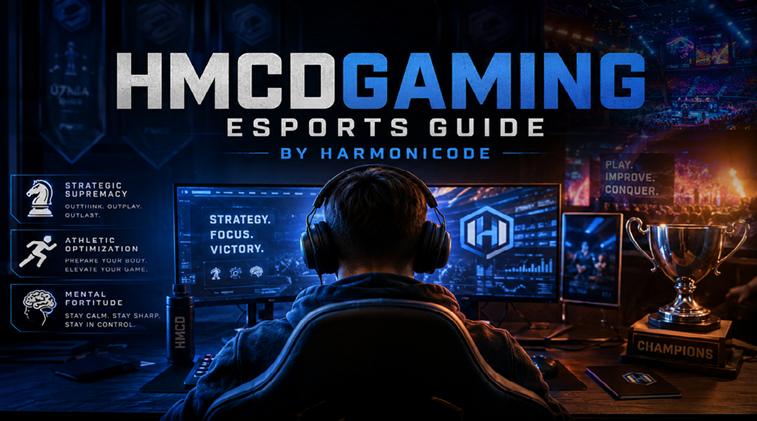
The guide identifies three core areas:
- Strategic Supremacy
- Athletic Optimization
- Mental Fortitude
Strategic Supremacy deals with understanding the game beyond basic mechanics. Athletic Optimization considers the player’s physical setup and readiness. Mental Fortitude addresses concentration, pressure, confidence, and decision-making.
Together, these areas create a more complete view of esports performance.
The same framework can also be adapted to different genres.
A tactical shooter demands positioning, aim, utility management, communication, and timing. A MOBA places greater emphasis on map awareness, objectives, resource management, and team coordination. Battle royale games add rotations, terrain, survival decisions, and late-game positioning to the equation.
The mechanics vary. The fundamentals of good competitive preparation do not.
The Three Pillars of Competitive Performance
1. Strategic Supremacy
Mechanical skill is easy to notice. Strategy often isn’t.
A player who wins an aim duel gets the highlight. A player who correctly predicts where that duel will happen may never receive the same attention.
Strong competitors constantly evaluate the situation around them.
They ask questions such as:
- What is the opposing team trying to accomplish?
- Which resources have they already used?
- Where is the next important engagement likely to happen?
- What information does my team currently lack?
- Which objective deserves priority?
- What happens if we lose the next fight?
Those questions lead to better decisions before the action begins.
Consider a tactical shooter. If an opposing team has already spent several key abilities, immediately forcing another fight may not be necessary. A disciplined team can instead use that information to create pressure and force the opponent into an uncomfortable position.
That’s strategic advantage without relying solely on superior aim.
2. Athletic Optimization
Gaming may happen while sitting at a desk, but physical readiness still matters.
The HMCDGaming framework considers posture, equipment, warmups, nutrition, and general readiness as part of the competitive setup.
The goal isn’t to build the most expensive gaming station possible. It’s to create a setup that remains comfortable and consistent during long sessions.
A practical setup should include:
- A comfortable chair and stable desk
- A monitor positioned at a comfortable height
- A mouse and keyboard that feel natural
- Consistent sensitivity settings
- Clear and reliable audio
- Regular movement breaks
- Adequate hydration
- A comfortable room temperature
Expensive equipment cannot fix poor decision-making.
In many cases, consistency is more valuable than price. A familiar mouse, stable settings, and reliable performance can be more useful than constantly replacing hardware.
3. Mental Fortitude
Competitive games can become stressful quickly.
A player loses several rounds and starts rushing. A teammate makes a mistake and frustration takes over. One bad play turns into three because the player keeps thinking about the original error.
Mental discipline helps stop that chain reaction.
A useful habit is to separate the mistake from the emotion surrounding it.
Instead of thinking, “I’m playing terribly,” ask:
“What decision caused that mistake, and what can I change on the next round?”
The second question is much more useful because it produces an actionable response.
Understanding Momentum Moments
One of the more interesting concepts in the HMCDGaming guide is the idea of Momentum Moments.
These are points in a match when one decision can have an unusually large effect on what happens next. The guide connects these situations with factors such as cooldowns, positioning, available resources, objectives, and opponent behavior.
Imagine a battle royale where a squad has strong weapons and plenty of ammunition. On paper, the team looks ready for the final fight.
Then the zone shifts.
The squad now has to cross open ground while another team controls elevated terrain.
The decisive mistake may not be the final gunfight. It may have been the earlier rotation.
That is the value of recognizing momentum moments. Players learn to look for the decision that shapes the next several plays rather than focusing only on the action happening right now.
How to Identify a Momentum Moment
Watch for changes involving:
- Major ability cooldowns
- Objective timers
- Enemy resource shortages
- Advantageous map positions
- Player eliminations
- Economy changes
- Information advantages
- Important power positions
- Late-game positioning
A useful question to ask during a match is:
“What could change the game within the next minute?”
That mindset encourages anticipation instead of constant reaction.
How to Train Like a Competitive Player
Playing more matches doesn’t automatically mean you’re improving.
Practice becomes more effective when every session has a purpose.
Build a Focused Training Routine
A practical session can include several stages:
| Training Area | Main Focus |
|---|---|
| Warmup | Hand movement and basic mechanics |
| Mechanics | Aim, movement, combos, or execution |
| Strategy | Maps, rotations, tactics, and positioning |
| Match Practice | Competitive gameplay |
| Review | Mistakes and successful decisions |
| Mental Reset | Short break between sessions |
The exact amount of time should depend on the player, game, schedule, and competitive goals.
The important part is deliberate practice.
If you repeatedly make the same mistake without reviewing it, playing another 50 matches may simply reinforce the habit.
Why Equipment Still Matters
Equipment cannot make a player great. It can, however, remove unnecessary obstacles.
The HMCDGaming guide discusses areas such as sensitivity, refresh rates, and audio configuration, particularly for competitive shooters.
A competitive setup should prioritize:
- Stable performance
- Low and consistent latency
- Comfortable controls
- Clear audio
- Reliable internet
- Consistent settings
Higher-refresh-rate displays can provide a smoother visual experience, but hardware should remain a tool rather than the focus of improvement.
Players should also resist the temptation to change settings constantly.
If you change sensitivity every few days, you never give yourself enough time to adapt properly. Test a setting, practice with it, and evaluate it over time.
A Practical Pre-Match Routine
A consistent pre-match routine can eliminate many avoidable problems.
Step 1: Check Your Setup
Make sure your mouse, keyboard, headset, monitor, and internet connection are working normally.
Step 2: Warm Up
Spend a short period practicing the mechanics you’ll need during the match.
Step 3: Review the Objective
Know exactly what your team needs to accomplish.
Step 4: Set One Mental Goal
Choose one specific behavior to focus on.
For example:
- Communicate clearly.
- Avoid unnecessary fights.
- Track enemy resources.
- Stay patient when the situation turns unfavorable.
Step 5: Start Fresh
Don’t carry frustration from the previous match into the next one.
A new game deserves a new decision-making process.
HMCDGaming vs. the Traditional “Just Grind More” Approach
The difference comes down to how practice is structured.
| Traditional Approach | HMCDGaming Approach |
|---|---|
| Play more hours | Practice specific weaknesses |
| Focus heavily on mechanics | Combine mechanics with strategy |
| Upgrade hardware | Optimize the entire setup |
| React to opponents | Anticipate important situations |
| Treat mental performance as secondary | Include mental preparation |
| Watch only highlights | Review mistakes and turning points |
| Practice alone | Consider team communication |
The HMCDGaming approach doesn’t suggest that mechanics are unimportant.
Instead, it puts mechanics inside a larger competitive system.
A player needs good aim. They also need to know when to use it.
Applying the Guide to Different Esports
The framework can be adapted to almost any competitive genre, although the specific priorities will change.
Tactical Shooters
Games such as VALORANT reward accurate shooting, but aim alone isn’t enough.
Players also need:
- Strong positioning
- Utility management
- Economy awareness
- Communication
- Map knowledge
- Timing
- Coordinated execution
Riot Games’ official VALORANT competitive ecosystem provides structured competition ranging from Premier toward Challengers and higher levels of organized play.
That structure illustrates an important point: serious competitive development involves more than ordinary ranked matches.
Players interested in organized competition should also understand current tournament rules and eligibility requirements.
MOBAs
MOBAs require a different type of decision-making.
Players should pay close attention to:
- Map awareness
- Objective control
- Resource management
- Team composition
- Timing
- Vision
- Communication
Individual mechanics can win an encounter, but a single poor objective decision may cost an entire game.
Battle Royale Games
Positioning becomes especially important in battle royale competition.
Players need to consider:
- Zone movement
- Enemy locations
- Available cover
- Team resources
- Rotation options
- End-game terrain
Sometimes the strongest play is avoiding a fight entirely.
Pros and Cons of the HMCDGaming Approach: HMCDGaming Esports Guide by Harmonicode
Pros
- Looks at competitive performance as a complete system
- Combines mechanics with strategy
- Gives mental preparation a meaningful role
- Encourages consistent equipment settings
- Highlights high-impact situations
- Can be adapted across multiple genres
Cons
- A broad framework cannot replace game-specific coaching
- Not every recommendation will suit every player
- Expensive hardware does not necessarily produce meaningful improvement
- General physical and nutrition guidance should remain appropriate and practical
- Consistent practice is still necessary
The framework works best as a foundation.
Players should adapt it to their game, role, experience level, and competitive goals.
Expert Tips for Better Esports Performance: HMCDGaming Esports Guide by Harmonicode
Review Your Losses
Don’t spend all your review time watching highlight clips.
Your losses often contain more useful information.
Find the first major mistake that changed the direction of the match. Then ask what information you had at that moment.
Could you have positioned differently?
Did you misunderstand the opponent?
Did you rush?
Those answers can guide your next practice session.
Track Patterns
Keep simple notes after competitive sessions.
Record recurring issues such as:
- Positioning mistakes
- Communication problems
- Mechanical weaknesses
- Poor decisions under pressure
- Successful strategies
Over time, patterns become easier to recognize.
Don’t Copy Professional Players Blindly
Professional settings can provide useful starting points.
They aren’t universal solutions.
A professional player’s sensitivity, keybinds, monitor settings, or hardware may reflect years of personal adaptation.
Use professional setups as references. Test them for yourself.
Communicate With Purpose
Good team communication delivers information teammates can act on.
Compare these two calls:
Weak: “He’s over there!”
Useful: “Two enemies pushing from B main.”
The second call provides location, quantity, and direction. Teammates can immediately make a decision from it.
Is HMCDGaming Useful for Beginners?
Yes, especially for beginners who want to develop good competitive habits early.
New players shouldn’t try to master every concept at once.
Start with three priorities:
- Learn the game’s core mechanics.
- Understand its basic win conditions.
- Review one meaningful mistake after each session.
Once those habits become natural, introduce more advanced strategy.
That approach keeps improvement manageable and gives players a clear path forward.
How to Use the Guide for Long-Term Improvement
Competitive improvement works best as a repeating cycle rather than a one-time effort.
Week 1: Identify Weaknesses
Play normally and record recurring mistakes.
Week 2: Target One Problem
Build practice around your most important weakness.
Week 3: Test Under Pressure
Take the new skill into ranked matches or tournament-style situations.
Week 4: Review
Compare your performance and identify what actually improved.
Then repeat the process.
This method is far more focused than simply increasing your total hours played.
(FAQs) About HMCDGaming Esports Guide by Harmonicode
1. What is the HMCDGaming esports guide by Harmonicode?
The HMCDGaming esports guide is a competitive gaming framework that brings together strategy, physical preparation, mental performance, equipment, and high-impact match situations.
2. What does HMCDGaming focus on?
HMCDGaming focuses on competitive gaming strategies, Momentum Moments, performance insights, gameplay analysis, and equipment optimization.
3. What are the three pillars of the Harmonicode approach?
The guide identifies Strategic Supremacy, Athletic Optimization, and Mental Fortitude as its three primary pillars.
4. What are Momentum Moments in esports?
Momentum Moments are high-impact situations where a decision, resource change, positioning advantage, or timing window can significantly affect a match.
5. Can beginners use the HMCDGaming guide?
Yes. Beginners can use its principles to build better practice habits, decision-making skills, communication, and competitive awareness.
6. Does better gaming equipment guarantee better results?
No. Good equipment can improve comfort and consistency, but it cannot replace practice, strategy, communication, or sound decision-making.
7. How can I improve my esports performance?
Start by identifying recurring mistakes. Then practice specific weaknesses, review matches, improve communication, and maintain consistent settings.
8. Is the guide useful for different esports genres?
Yes. The broader principles can apply to shooters, MOBAs, battle royale games, fighting games, and other competitive titles. The specific application will vary by genre.
9. Should players copy professional gaming settings?
Not automatically. Professional settings can provide a useful starting point, but every player should test configurations based on their own mechanics, hardware, and comfort.
10. Where can players find official esports rules?
The best source is the game’s publisher or tournament organizer. Players should check official documentation for the latest eligibility requirements, competition formats, and rules.
For VALORANT, Riot Games provides competitive rules, policies, and tournament documentation through its official Competitive Operations resources.
Conclusion: HMCDGaming Esports Guide by Harmonicode
The hmcdgaming esports guide by harmonicode offers a broader way to think about competitive gaming.
Mechanical ability still matters, but it doesn’t exist in isolation. Strategy, preparation, communication, mental control, equipment consistency, and situational awareness all influence the quality of a player’s decisions.
The concept of Momentum Moments is especially useful because it encourages players to think beyond the current fight. Instead of reacting to everything as it happens, competitors can learn to identify the situations that are likely to shape what comes next.