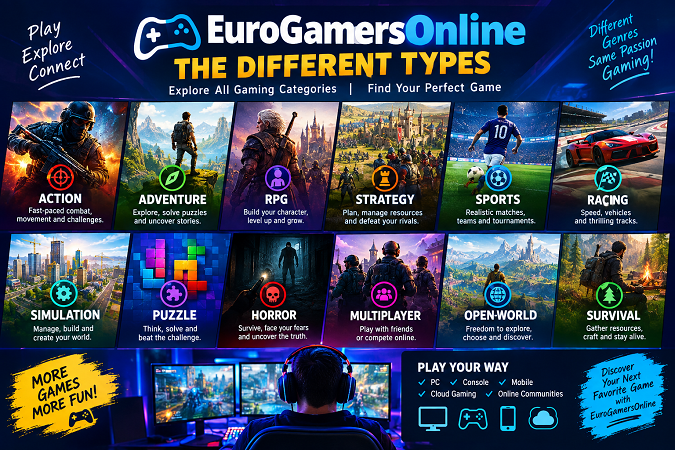

The gaming world has expanded far beyond traditional console and PC games. Today, players can choose from thousands of experiences across mobile devices, computers, consoles, cloud platforms, and online communities. With so many options available, gaming websites and digital platforms often organise games into different categories to make discovery easier. Understanding eurogamersonline the different types can help readers explore the broad range of gaming experiences available across modern gaming culture.
EuroGamersOnline can be viewed as a useful topic for discussing the different types of games, gaming genres, platforms, player experiences, and digital entertainment categories that make up the wider gaming ecosystem. From action and adventure games to strategy, sports, simulation, role-playing, and multiplayer experiences, each category offers something different.
This guide explains the major types of gaming content and genres associated with the topic. It also explores how game categories differ, what makes each type interesting, and how players can choose an experience that matches their interests.
Also Read: Etruesports Etsjavaapp Guide
What Does “EuroGamersOnline” Mean for the Different Types? Mean?
The phrase eurogamersonline the different types can refer broadly to the different categories of games and gaming experiences that players may discover through online gaming communities and gaming-focused websites. Rather than representing one specific game type, it can be used as a search phrase for exploring gaming categories.
Modern games are usually classified according to gameplay mechanics, objectives, presentation, platform, and player interaction. For example, an action game may focus on fast reactions, while a strategy game emphasises planning and decision-making. A simulation game attempts to recreate real-world or fictional activities, while a role-playing game usually focuses on character development and progression.
These categories are not always completely separate. Many modern games combine multiple genres. A title might include role-playing mechanics, action combat, open-world exploration, multiplayer features, and strategy elements at the same time.
Why Are Gaming Types Important?
Game categories make it easier for players to discover experiences they are likely to enjoy. Someone who enjoys competition may prefer multiplayer or sports games, while another player might prefer a relaxing simulation or puzzle experience.
Genres also help developers communicate the basic nature of a game. A player can often understand the general gameplay style from a simple genre description.
For gaming websites and online communities, categories provide an organized way to discuss new releases, updates, guides, reviews, and gaming trends. This makes it easier for visitors to navigate a large amount of gaming information.
1. Action video games
One of the most recognisable gaming genres is action. Action games are typically real-time challenges, decision-making, fighting, movement, fast reactions and challenges.
Players may need to defeat opponents, avoid obstacles, complete missions, or survive increasingly difficult situations. Some action games are designed around straightforward combat, while others combine action with exploration or storytelling.
Modern action games can appear on virtually every major gaming platform. They may include single-player campaigns, cooperative modes, competitive multiplayer, or a combination of these features.
2. Adventure Games
Adventure games generally emphasise exploration, discovery, storytelling, puzzles, and interaction with virtual environments.
Instead of focusing entirely on combat, adventure titles may encourage players to investigate locations, communicate with characters, collect objects, solve problems, and uncover a larger story.
Adventure gaming can appeal to players who enjoy narrative experiences and exploration. Some games combine adventure mechanics with action, role-playing, or survival systems.
3. Role-Playing Games
Role-playing games, commonly called RPGs, allow players to control characters who develop over the course of a game.
Character progression is often a major feature. Players may gain experience, unlock abilities, improve equipment, make decisions, or customise their characters.
RPGs can vary significantly. Some are built around turn-based combat, while others use real-time combat. Some emphasise storytelling, whereas others focus heavily on exploration, character building, or multiplayer progression.
The flexibility of the RPG format makes it one of the most diverse gaming categories.
4. Strategy Games
Strategy games focus on planning, resource management, tactical decisions, and long-term thinking.
Players may control armies, build civilisations, manage resources, develop territories, or compete against opponents through carefully planned actions.
Strategy games can be divided into several subcategories. Real-time strategy requires players to make decisions while the game continues, whereas turn-based strategy allows players to act within defined turns.
These games can be especially appealing to players who enjoy problem-solving and decision-making.
5. Sports Games
Sports games recreate real-world or fictional sporting activities. Popular examples of sports categories include football, basketball, racing, tennis, golf, and other competitive activities.
These games often feature realistic controls, teams, leagues, tournaments, career modes, and multiplayer competitions.
Sports games can provide both casual and competitive experiences. Some players enjoy short matches, while others spend significant time developing teams or completing long-term career modes.
6. Racing Games
Racing games focus on speed, vehicles, tracks, competition, and driving challenges.
Some racing games aim for realistic simulation, while others provide arcade-style gameplay with exaggerated movement and accessible controls.
Vehicle customisation is another common feature. Depending on the title, players may modify performance, appearance, handling, or other aspects of their vehicles.
Racing games can be played alone, against computer-controlled opponents, or against other players online.
7. Simulation Games
Simulation games attempt to recreate activities, systems, or environments.
Players might manage a city, operate a vehicle, run a business, build a home, manage a farm, or perform another activity through a virtual environment.
Simulation games are often more focused on systems and decision-making than traditional action games. Their pace can also be slower, making them appealing to players who prefer planning and experimentation.
8. Puzzle Games
Puzzle games are built around problem-solving challenges. These challenges can involve logic, patterns, numbers, words, spatial relationships, or timing.
Puzzle games are often accessible because they do not necessarily require complex controls. However, difficulty can range from very simple challenges to extremely demanding problems.
The category works well on mobile devices because many puzzle games can be played in short sessions.
9. Horror Games
Horror games are designed to create tension, suspense, fear, or uncertainty.
Common elements include dark environments, atmospheric sound, unexpected events, limited resources, mysterious characters, and survival challenges.
Some horror games emphasise psychological storytelling, while others rely more heavily on survival mechanics or direct encounters with enemies.
The genre has developed many subcategories, including survival horror, psychological horror, and action horror.
10. Multiplayer Online Games
Multiplayer online games allow players to interact with other people through an internet connection.
Depending on the game, players may cooperate with teammates, compete against opponents, communicate through built-in systems, or participate in large virtual communities.
Online multiplayer has become an important part of modern gaming. Competitive matches, cooperative missions, seasonal events, leaderboards, and community activities can encourage players to return regularly.
11. Open-World Games
Open-world games provide players with relatively large environments to explore. Instead of following a strictly linear path, players can often choose where to travel and which activities to complete.
Open-world games may include missions, side activities, collectibles, exploration, character development, vehicles, crafting, or environmental interactions.
The open-world format is not technically a traditional genre in every classification system. Instead, it is often a design structure that can be combined with action, RPG, adventure, survival, and other genres.
12. Survival Games
Survival games challenge players to remain alive while managing limited resources and environmental dangers.
Players may need to collect materials, construct shelters, find food, craft equipment, and protect themselves from threats.
Some survival games are single-player, while others allow players to cooperate or compete online. Crafting and resource management are particularly common mechanics.
Comparison Table: Different Types of Games
| Game Type | Main Focus | Common Features | Suitable For |
|---|---|---|---|
| Action | Fast gameplay | Combat, movement, missions | Action-orientated players |
| Adventure | Exploration and story | Puzzles, discovery, characters | Story-focused players |
| RPG | Character progression | Levels, abilities, equipment | Players who enjoy development |
| Strategy | Planning | Resources, tactics, management | Strategic thinkers |
| Sports | Competition | Matches, teams, tournaments | Sports fans |
| Racing | Speed and driving | Vehicles, tracks, customisation | Racing enthusiasts |
| Simulation | Real-world systems | Management, building, activities | Creative and methodical players |
| Puzzle | Problem-solving | Logic, patterns, challenges | Puzzle enthusiasts |
| Horror | Suspense and fear | Atmosphere, survival, mystery | Horror fans |
| Multiplayer | Social competition/cooperation | Online matches, teams | Social gamers |
| Open World | Exploration | Large maps, missions, activities | Explorers |
| Survival | Resource management | Crafting, collecting, shelter | Survival-focused players |
How Gaming Genres Are Combined: EuroGamersOnline The Different Types
One of the most interesting aspects of modern gaming is the combination of different categories.
A game can be an action RPG, for example, combining real-time combat with character progression. Another title may combine survival mechanics with open-world exploration. A sports game can also include management and simulation features.
These combinations give developers more freedom to create unique experiences. They also mean that players should not assume a single genre label describes everything a game offers.
For people researching eurogamersonline the different types, understanding of genre combinations is particularly useful because modern games frequently cross traditional category boundaries.
Choosing the Right Type of Game: EuroGamersOnline The Different Types
Choosing a game depends largely on personal preferences.
Players who enjoy fast-paced experiences may prefer action or racing games. Those who like stories might enjoy adventure and RPG titles. People who prefer strategic thinking could explore strategy and simulation games.
Players who enjoy social interaction may prefer multiplayer games, while people looking for short sessions may find puzzle or mobile-friendly games more convenient.
Another important factor is platform. A game available on PC may have different controls and performance characteristics from a mobile version. Console players may also have access to platform-specific features.
The Role of Online Gaming Communities: EuroGamersOnline The Different Types
Online communities play an important role in modern gaming culture. Players share recommendations, strategies, updates, gameplay experiences, and technical information.
Gaming websites can also organise content into categories such as news, reviews, guides, features, updates, and gaming technology. This organisation helps readers quickly locate information relevant to their interests.
For users researching different gaming types, online communities can provide additional perspectives about gameplay mechanics, difficulty, features, and player experiences.
Gaming Types Across Different Platforms: EuroGamersOnline The Different Types
PC Gaming
PC gaming supports a huge range of genres, from strategy and simulation to competitive multiplayer and role-playing games. PCs can also support extensive customisation, depending on the hardware and software.
Console Gaming
Consoles provide dedicated gaming experiences with standardised hardware and controller-based input. Action, sports, racing, adventure, and RPG games are particularly common across console platforms.
Mobile Gaming
Mobile gaming has made games accessible through smartphones and tablets. Puzzle, casual, strategy, simulation, and multiplayer games are widely represented in the mobile ecosystem.
Cloud Gaming
Cloud gaming allows compatible games to be streamed through internet-connected devices. The technology can reduce the need for users to install large game files locally, although performance depends on factors such as network quality and service availability.
The Future of Different Gaming Types
Gaming categories will likely continue evolving as technology changes. Artificial intelligence, cloud infrastructure, virtual reality, augmented reality, improved graphics, and new control methods can influence how games are designed.
Rather than replacing traditional genres, new technology may expand them. For example, simulation games could become more interactive, multiplayer environments could become more immersive, and adventure games could use new forms of storytelling.
The growing overlap between genres is also likely to continue. Future games may combine several mechanics into a single experience instead of fitting neatly into one traditional category.
(FAQs): EuroGamersOnline The Different Types
What does “eurogamersonline the different types” mean?
The phrase can be used to explore the different types of games and gaming categories associated with online gaming content, including action, RPG, strategy, sports, simulation, puzzle, and multiplayer games.
What are the main types of video games?
Major categories include action, adventure, role-playing, strategy, sports, racing, simulation, puzzle, horror, survival, and multiplayer games.
What is an RPG game?
An RPG, or role-playing game, generally focuses on controlling a character or group of characters while developing abilities, equipment, statistics, or story progression.
What is an open-world game?
An open-world game provides a relatively large environment where players can explore and complete activities with greater freedom than in a strictly linear game.
Are multiplayer and online games the same thing?
They can overlap, but not every multiplayer game requires an internet connection. Some multiplayer experiences can be played locally, while online multiplayer uses internet connectivity.
Which gaming type is best for beginners?
There is no universal choice. Beginners can select a genre based on their interests and preferred level of complexity. Puzzle, casual, sports, and accessible adventure games can be starting points, while strategy and simulation games may offer more complex systems.
Can one game belong to multiple categories?
Yes. Modern games frequently combine genres. For example, a title can combine action, RPG, open-world, survival, and multiplayer mechanics.
Why are gaming categories useful?
Categories help players understand the basic gameplay style of a title and make it easier to discover games that match their interests.
What factors should I consider when choosing a game?
Consider gameplay style, platform, difficulty, single-player or multiplayer features, available time, story preferences, and whether you prefer competition, exploration, creativity, or strategy.
Will gaming genres change in the future?
Gaming genres are continually evolving. New technology and changing player expectations can introduce new mechanics and encourage developers to combine existing categories in new ways.
Conclusion: EuroGamersOnline The Different Types
Understanding eurogamersonline the different types provides a useful starting point for exploring the broad world of modern gaming. Action, adventure, RPG, strategy, sports, racing, simulation, puzzle, horror, multiplayer, open-world, and survival games each offer different experiences.
The best category for a player depends on personal interests, preferred platform, available time, and desired style of gameplay. Some players prefer competition, while others enjoy storytelling, exploration, creativity, strategy, or social interaction.
Because modern games increasingly combine multiple genres, players can discover experiences that offer several different styles within one title. Exploring these categories can therefore make it easier to understand the gaming landscape and discover new types of entertainment.



Pingback: Eurogamersonline.com Gadgets – Gaming Gear Guide 2026
Pingback: EuroGamersOnline From Consoles to Casinos – Gaming Evolution