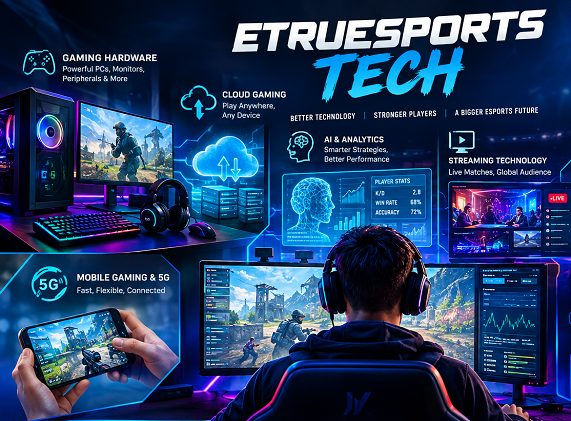

The gaming industry is changing faster than ever, and technology is at the centre of that transformation. From powerful gaming computers and high-refresh-rate monitors to artificial intelligence, cloud gaming, virtual reality, and advanced esports platforms, modern gaming has become much more than entertainment. EtrueSports tech represents the growing connection between gaming, competitive esports, digital innovation, and the technologies that make interactive experiences faster, smarter, and more immersive.
Gamers today expect smooth performance, low latency, high-quality graphics, reliable online connections, and competitive features. Esports players have even higher expectations because a small technical problem can affect an entire match. As gaming continues to become more competitive and professional, technology is becoming one of the most important factors behind player performance and viewer engagement.
Understanding etruesports tech can therefore help gamers, esports enthusiasts, content creators, and technology fans understand where the industry is heading. This article explores major gaming technologies, esports hardware, software innovations, artificial intelligence, cloud gaming, streaming, cybersecurity, and the future of competitive gaming.
Also Reed: Gaming News eTrueSports & eTesportech
What Is EtrueSports Tech?
The term etruesports tech can be used to describe the technology, tools, platforms, hardware, software, and digital innovations connected with modern esports and gaming. It covers a broad range of technologies that help players compete, teams train, tournaments operate, and audiences watch gaming events.
Gaming technology includes devices such as gaming PCs, laptops, consoles, keyboards, mice, headsets, monitors, controllers, and networking equipment. However, the technology behind esports goes much further. Tournament platforms, matchmaking systems, analytics tools, streaming software, anti-cheat systems, artificial intelligence, and cloud infrastructure all contribute to the modern esports ecosystem.
The development of these technologies has made competitive gaming more accessible and professional. Players can train from home, compete with people around the world, broadcast their gameplay, analyze their performance, and build online communities.
Why EtrueSports Tech Matters
Technology plays an essential role in competitive gaming because esports depends on speed, accuracy, stability, and communication. A player may have excellent skills, but poor hardware or an unstable internet connection can negatively affect performance.
Modern esports technology aims to reduce these problems. High-refresh-rate displays can make fast-moving gameplay appear smoother. Responsive peripherals can help players react quickly. Powerful processors and graphics hardware can deliver higher frame rates. Meanwhile, optimized networks can reduce latency during online matches.
Technology also benefits tournament organisers and viewers. Modern esports events can use sophisticated production systems, real-time statistics, replay technology, digital broadcasts, and interactive platforms to create more engaging experiences.
Major Technologies Behind Modern Esports
The esports ecosystem depends on several categories of technology. Each category contributes to competitive performance and the overall gaming experience.
| Technology | Main Purpose | Benefit for Esports |
|---|---|---|
| Gaming PCs | Run demanding games | High performance and frame rates |
| Gaming monitors | Display gameplay | Smooth visuals and fast response |
| Mechanical keyboards | Precise controls | Fast and consistent inputs |
| Gaming mice | Accurate aiming | Better precision |
| Headsets | Audio and communication | Clear team communication |
| High-speed internet | Online connectivity | Lower latency and stability |
| Cloud technology | Remote computing and services | Flexible access and scalability |
| AI tools | Analysis and automation | Better training and insights |
| Streaming technology | Broadcast gameplay | Wider audience reach |
| Anti-cheat software | Protect competitive integrity. | Fairer matches |
Gaming Hardware and Performance
Hardware is one of the most visible parts of etruesports tech. Professional and serious competitive gamers often pay close attention to every component of their setup.
A powerful gaming PC can provide high frame rates and stable performance in demanding titles. Modern graphics processing units can render detailed environments while powerful CPUs handle game logic, background processes, and other tasks.
Monitors are equally important. Competitive gamers frequently prefer displays with high refresh rates and fast response times because these features can make motion appear smoother and controls feel more responsive.
Peripherals also matter. Gaming mice, mechanical keyboards, controllers, and headsets are designed to provide consistent input and communication. Professional players may customise sensitivity, key bindings, mouse shapes, audio settings, and other features according to their individual preferences.
The Role of Artificial Intelligence in Esports
Artificial intelligence is becoming an increasingly important part of gaming technology. AI can potentially help players understand their performance by analysing gameplay data and identifying patterns.
For example, AI-based systems can analyse statistics such as accuracy, movement, positioning, reaction patterns, and decision-making. Coaches and players can use this information to identify weaknesses and improve training routines.
AI can also support tournament operations, moderation, automated highlights, customer support, and content creation. As the technology improves, its role in esports is likely to become even more significant.
However, responsible use is important. Competitive gaming needs clear rules regarding AI-assisted tools, especially when such tools could provide an unfair advantage during live matches.
Cloud Gaming and Esports
Cloud technology is another major development in the gaming industry. Traditional gaming often requires users to own powerful hardware capable of running games locally. Cloud gaming moves some of that computing workload to remote servers.
For esports, cloud technology can provide scalable infrastructure for online services, game distribution, data storage, and tournament platforms. It can also help organisations manage large amounts of data.
Cloud gaming still faces challenges, particularly around internet speed, latency, reliability, and server availability. Competitive esports requires extremely responsive gameplay, so reducing the distance between players and servers remains important.
Nevertheless, improvements in cloud infrastructure could make gaming more accessible and flexible in the future.
Internet Speed and Low Latency
A strong internet connection is critical for online esports. Latency, often measured in milliseconds, describes the delay between an action and the corresponding response from an online server.
Lower latency is generally desirable for competitive games. High latency can create delays that make aiming, movement, timing, and communication more difficult.
Modern esports technology therefore focuses on improving network infrastructure and server performance. Competitive players often choose internet services and server locations that provide stable connections.
It is important to remember that internet speed and latency are not exactly the same thing. A connection can have high download speed while still experiencing poor latency or instability. For competitive gaming, consistency is often just as important as raw speed.
Streaming and Esports Broadcasting
Streaming has transformed gaming from a private activity into a global entertainment industry. Platforms that allow gamers to broadcast their gameplay have helped create new careers for streamers, commentators, content creators, and esports professionals.
Modern broadcasting technology can provide high-definition video, multiple camera angles, live statistics, instant replays, player information, chat interaction, and other features.
Esports organisations can also use social media and video platforms to reach audiences beyond traditional tournament venues. This makes technology essential not only for players but also for the business and media side of esports.
Virtual Reality and Augmented Reality
With the advent of virtual reality and augmented reality, new opportunities might open up for gaming and esports.
Virtual reality puts players in a world that is generated by a computer. Augmented reality puts digital elements or information over the real world.
These technologies can create more immersive gaming experiences.
Although VR esports is not yet as dominant as traditional competitive gaming, improvements in headsets, motion tracking, graphics, and wireless technology could encourage more competitive applications.
Augmented reality may also influence esports broadcasts by adding statistics, player information, graphics, and interactive elements to live viewing experiences.
Cybersecurity and Anti-Cheat Technology
Fair competition is one of the most important principles in esports. As tournaments become more valuable, cybersecurity and anti-cheat technology become increasingly important.
Anti-cheat systems are designed to identify unauthorised software or suspicious behaviour. Security technology can also protect tournament platforms, player accounts, organisational data, and online infrastructure.
Esports organisations must continually improve their security practices because attackers and cheating methods can also evolve.
A secure esports environment helps protect players, teams, tournament organizers, sponsors, and audiences.
Data Analytics in Competitive Gaming
Data has become a powerful tool for esports teams. Players and coaches can analyse match statistics to understand performance and develop better strategies.
Analytics may include kill-to-death ratios, accuracy, objective performance, movement patterns, resource usage, map positioning, and team coordination.
Instead of relying entirely on intuition, coaches can combine experience with data-driven insights. This can make training more structured and help teams identify areas that require improvement.
As analytics tools become more advanced, data may become an even larger part of professional esports.
Mobile Gaming Technology
Esports is not limited to desktop computers and consoles. Mobile gaming has created a massive competitive ecosystem.
Modern smartphones contain powerful processors, advanced graphics capabilities, high-refresh-rate displays, and increasingly sophisticated networking technologies. These features allow competitive games to run directly on mobile devices.
Mobile esports can also be more accessible because many people already own smartphones. This lowers the hardware barrier for entering gaming communities and competitive tournaments.
The continued development of mobile processors, displays, cooling systems, controllers, and network technology is likely to strengthen the role of mobile esports.
EtrueSports Tech and the Future of Gaming
The future of etruesports tech will likely involve greater integration between hardware, software, artificial intelligence, cloud computing, analytics, and immersive technologies.
Gaming devices are becoming more powerful while software is becoming more intelligent. AI could help personalise training. Cloud infrastructure could improve scalability. Better networks could reduce latency. Advanced displays could provide smoother visuals.
At the same time, esports may become increasingly professionalised. Teams could use more sophisticated performance laboratories, analytics systems, coaching platforms, and training environments.
The industry will also need to address challenges such as privacy, cybersecurity, cheating, digital well-being, accessibility, and responsible use of emerging technologies.
How Gamers Can Benefit From Gaming Technology
Gamers do not necessarily need the most expensive equipment to benefit from technology. Instead, they should focus on components that match their games and goals.
Competitive FPS players may prioritize a responsive mouse, high-refresh-rate monitor, comfortable headset, and stable network. Strategy gamers may focus more on processing performance and display quality. Mobile players may prioritize touch responsiveness, thermal performance, battery life, and network stability.
The best setup is therefore not necessarily the most expensive setup. It is the setup that provides reliable performance and fits the player’s needs.
Key Trends in EtrueSports Tech
Several trends are likely to remain important in the coming years:
- Artificial intelligence: More sophisticated game analysis and personalised training.
- Cloud infrastructure: Greater use of remote servers and scalable gaming services.
- High-refresh-rate displays: Continued improvement in competitive gaming monitors.
- Mobile esports: Increasingly powerful smartphones and competitive mobile games.
- Immersive technology: More experimentation with VR and AR.
- Advanced analytics: Greater use of performance data by teams and coaches.
- Cybersecurity: Stronger systems for protecting players and tournaments.
- Streaming innovation: More interactive and data-rich esports broadcasts.
(FAQs): About EtrueSports Tech
What does etruesports tech mean?
EtrueSports tech refers broadly to technologies associated with gaming and esports, including hardware, software, networking, artificial intelligence, analytics, streaming, cloud services, and competitive gaming infrastructure.
Why is technology important in esports?
Technology helps provide reliable gameplay, responsive controls, clear communication, online connectivity, tournament management, performance analysis, and high-quality broadcasts.
Is expensive gaming hardware necessary for esports?
Not always. High-end hardware can improve performance, but players should choose equipment based on the requirements of their games, personal preferences, and budget.
How does AI affect esports?
AI can assist with gameplay analysis, training insights, statistics, moderation, content creation, and tournament operations. Its use during competitive matches may be restricted depending on tournament rules.
Does internet speed affect competitive gaming?
Yes, but latency and connection stability are particularly important. A stable connection with low latency can be more valuable for competitive play than simply having extremely high download speeds.
Will cloud gaming replace gaming PCs?
It is unlikely that cloud gaming will completely replace local gaming hardware in the near future. Both approaches have advantages, and competitive gaming still places strong demands on latency and reliability.
Is mobile gaming part of esports technology?
Yes. Mobile gaming is an important part of the esports ecosystem, supported by powerful smartphones, high-refresh-rate screens, advanced processors, networking technology, and mobile gaming accessories.
What is the future of etruesports tech?
The future is likely to include stronger AI tools, better analytics, faster networks, improved hardware, cloud infrastructure, immersive technologies, and more sophisticated esports broadcasting.
Conclusion: EtrueSports tech
EtrueSports tech represents the continuing evolution of gaming through technology and innovation. From powerful gaming hardware and low-latency networks to artificial intelligence, cloud computing, data analytics, streaming, and immersive technologies, modern esports depends on a broad technology ecosystem.
Better technology can help players train more effectively and play more smoothly. Analytics and artificial intelligence may provide new perspectives on performance for teams. Technology can help tournament organisers improve security, competition management, and broadcasting. It can also enhance more interactive and engaging esports experiences for viewers.
As gaming continues to grow globally, technology will remain one of its most important driving forces. The next generation of etruesports tech may make competitive gaming faster, smarter, more accessible, and more immersive than ever before.