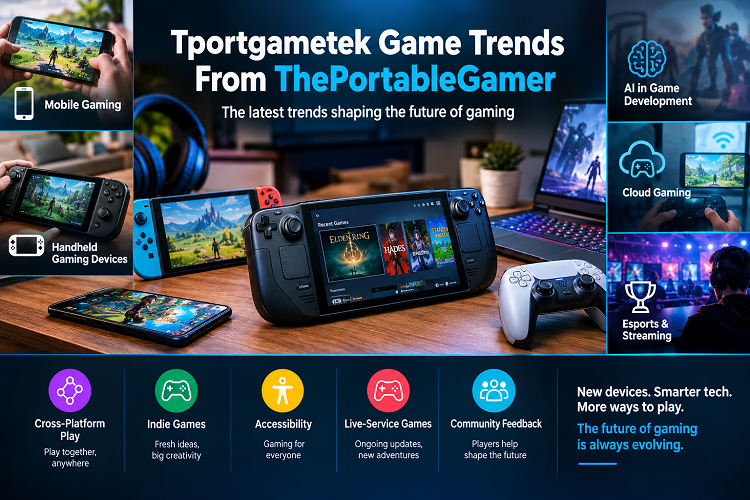

Gaming has grown far beyond living room consoles and high-end desktop PCs. Today, players can compete on smartphones, stream games through the cloud, or carry entire PC game libraries in handheld devices. Meanwhile, developers are experimenting with artificial intelligence, accessibility tools, and new ways to keep players engaged. These changes make tportgametek game trends from theportablegamer a useful topic for anyone interested in the direction of modern gaming. Whether you’re a casual player, a competitive gamer, or someone researching gaming technology, understanding these developments can help you make better decisions.
Not every new feature deserves attention, however. A viral game can disappear from the spotlight within weeks, while an expensive gaming device might offer little benefit to someone who plays casually. The challenge is separating genuine progress from marketing hype.
This guide examines the gaming trends worth watching, explains how they affect everyday players, and offers practical advice for choosing games, evaluating technology, and finding reliable information.
Editorial note: The phrase “Tportgametek” does not establish a recognised industry standard. This article explores the topic as a broader discussion of gaming trends rather than presenting it as a verified research framework.
Also Read: Latest News PlayMyWorld: Gaming Updates for 2026
What Are Tportgametek Game Trends From ThePortableGamer?
The phrase tportgametek game trends from theportablegamer can be understood as a search topic focused on gaming technology, portable entertainment, and changes in player behaviour.
It covers several connected areas, including handheld devices, mobile gaming, cloud-based services, competitive gaming, and the software tools developers use to build better experiences.
Consider a player deciding between a handheld gaming PC and a traditional console. Another might want to know whether cloud gaming can eliminate the need for expensive hardware. A competitive player may care more about latency, frame rates, and controller responsiveness.
Each question reflects a different side of the same industry.
A useful analysis of gaming trends should examine three things:
- Technology: What new capabilities are becoming available?
- Player behaviour: Are gamers adopting these features, or are they generating only temporary interest?
- Practical value: Does the change improve performance, convenience, accessibility, or enjoyment?
Looking at all three helps readers make informed decisions instead of following every new announcement.
The Biggest Gaming Trends to Watch: tportgametek game trends from theportablegamer
1. Mobile Gaming Continues to Shape the Industry
Mobile gaming remains a major part of the entertainment market because smartphones make games accessible to a broad audience. Players can enjoy puzzles, strategy games, racing titles, multiplayer shooters, and role-playing adventures without buying a dedicated console.
Developers have also improved touch controls, graphics, multiplayer features, and controller support. Some mobile games now offer extensive online experiences that previously required more specialized hardware.
For American players, the appeal is straightforward. A smartphone makes it easy to play during a commute, between classes, or while waiting for an appointment.
Still, convenience comes with trade-offs. Demanding games can drain batteries, generate heat, and consume considerable storage. In-app purchases and limited-time promotions can also encourage spending beyond the original budget.
Before downloading a game, check its device requirements, privacy permissions, controller compatibility, and monetisation model. A free download can become expensive if progression depends heavily on paid upgrades.
2. Handheld Gaming Devices Offer More Flexibility
Portable gaming has moved well beyond simple handheld consoles. Modern devices let players enjoy console-style experiences or access PC game libraries without sitting at a desk.
Three products illustrate the different approaches.
Nintendo Switch
The Nintendo Switch combines handheld play with television gaming through its dock. Its appeal comes from its flexible design, approachable setup, and access to Nintendo’s exclusive games.
Steam Deck
The Steam Deck gives players portable access to a substantial Steam library. However, compatibility varies, and demanding games may require reduced graphics settings to run smoothly.
ASUS ROG Ally
The ASUS ROG Ally runs Windows and provides access to PC games through supported launchers and shopfronts. That flexibility can be valuable, although Windows may require more configuration than a dedicated console interface.
The right device depends on how and where you play. Battery life, weight, screen quality, storage, game compatibility, and total cost all deserve consideration.
For example, someone who travels frequently may prefer a lighter device with strong battery life. A player who mostly games at home might value performance and screen quality instead.
Before buying, check whether your favourite titles run properly and whether they support offline play. Those details can matter more than a long list of technical specifications.
3. Cloud Gaming Reduces the Need for Powerful Hardware
Cloud gaming lets players run supported games on remote servers and stream the results to their devices. Depending on the service, a compatible television, computer, tablet, or phone may be enough to get started.
Services such as Xbox Cloud Gaming and NVIDIA GeForce NOW demonstrate how this model works.
The attraction is simple: players may access demanding games without purchasing a high-end gaming PC. Cloud gaming can also make it easier to move between compatible devices.
There are limitations, though. Streaming quality depends on internet speed, network stability, server availability, and the service’s terms. Even a fast connection can experience latency when the network becomes congested.
That delay can be particularly noticeable in competitive shooters, fighting games, and other titles that demand precise timing.
Game availability also varies. A subscription does not automatically include every game, and some services require players to own supported titles separately.
Practical tip: Test cloud gaming during the hours you normally play. Check how the service performs on your actual network before committing to a long subscription.
4. Artificial Intelligence Is Changing Game Development
Artificial intelligence is becoming part of the development process, helping studios handle certain tasks more efficiently.
Potential applications include automated testing, animation assistance, player-behaviour analysis, content moderation, and procedural content generation. AI-driven characters may also become more responsive to player decisions as developers refine the technology.
These tools could help studios identify bugs earlier, explore design ideas, and create more dynamic interactions. However, the results depend on implementation and human oversight.
AI-generated dialogue can feel repetitive. Automated testing may miss subtle gameplay problems, and generated assets can raise questions about copyright, consent, and creative ownership.
Players should also consider how developers handle voice likenesses and personal data when introducing AI-powered features.
The real measure of progress is not whether a game uses AI. It’s whether the technology improves the experience without compromising quality, privacy, or creative integrity.
5. Cross-Platform Play Makes Multiplayer More Accessible
Cross-platform play allows users on different supported devices to play together. A console player might join friends on a PC or another console without everyone purchasing the same hardware.
For groups with mixed devices, this feature can make multiplayer gaming much easier.
Cross-progression offers another advantage. When a game supports it, players can carry certain progress, unlocks, or account information between platforms.
However, these features are not universal. Some games restrict cross-play, while others separate players according to their input method. Progression and purchased content may also behave differently across platforms.
Before investing time in a multiplayer game, check its cross-play policy, account-linking requirements, and progression rules. Doing so can prevent frustrating surprises later.
6. Esports and Streaming Influence Game Discovery
Competitive gaming and live streaming have become important ways for players to discover new titles. Tournament highlights, creator recommendations, and community challenges can introduce games to audiences who might otherwise overlook them.
Esports offers more than professional competition. Fans can study strategies, follow teams, watch commentary, and participate in amateur leagues.
Streaming also provides a useful preview before a purchase. Watching ordinary gameplay reveals a game’s pace, visual style, difficulty, and multiplayer atmosphere more clearly than a promotional trailer alone.
Still, popularity should not be confused with quality. A game may attract attention because of a viral moment, a major tournament, or controversy rather than its long-term appeal.
Look beyond viewer counts. Watch full gameplay sessions, read recent player reviews, and check whether the developer continues to support the game.
7. Indie Games Continue to Deliver Fresh Ideas
Independent developers often experiment with unusual mechanics, distinctive art styles, and stories that larger studios might consider commercially risky.
These games demonstrate that impressive graphics and enormous budgets are not the only routes to success. A clever gameplay system, memorable characters, and strong community support can help a smaller release find an audience.
Players can discover indie games through digital shopfronts, gaming festivals, creator recommendations, and curated collections.
However, quality and long-term support vary. Early access games may change substantially before release, and smaller studios may have limited resources for ongoing updates.
Before purchasing an unfamiliar title, watch hands-on gameplay and look for recent reviews. Check whether the developer communicates clearly about known problems and future plans.
For anyone following gaming trends, indie releases deserve attention because they can introduce ideas that later influence larger productions.
8. Accessibility Is Becoming an Essential Part of Game Design
Accessibility features help more people enjoy games, including players with visual, hearing, mobility, or cognitive disabilities.
Useful features include:
- Adjustable subtitle size, color, and background contrast.
- Colorblind-friendly indicators.
- Remappable controls and alternative input methods.
- Difficulty settings and optional assist modes.
- Adjustable camera sensitivity and aiming controls.
- Screen narration and clearer interface elements.
These options can improve the experience for many players, not just those who need specific accommodations. Larger subtitles, for example, can help someone playing on a television across the room.
The Entertainment Software Association’s industry research also illustrates the breadth of the American gaming audience. Developers who consider different player needs can make their games more welcoming and easier to use.
When evaluating a new release, check its accessibility menu before assuming the default settings are the only available options.
9. Live-Service Games Must Continue to Earn Players’ Time
Live-service games receive ongoing updates, seasonal events, new content, and other additions after launch. This model can keep a title active for years, but it also encourages players to return regularly.
Battle passes, downloadable content, cosmetic purchases, and limited-time events can support continued development. They can also create pressure to log in frequently or spend more than expected.
Before committing to a live-service game, ask yourself:
- Can I enjoy the game without making extra purchases?
- Can I earn worthwhile rewards through regular play?
- Does the developer communicate updates and changes clearly?
- What happens to purchased content if the service closes?
- Does the game fit my schedule, or does it make gaming feel like a chore?
A free-to-play label does not guarantee a free long-term experience. Consider the likely cost over several months rather than focusing only on the initial download.
The strongest live-service games give players meaningful reasons to return without making every session feel like an obligation.
10. Community Feedback Helps Shape Games
Players have more ways than ever to communicate with developers. They report bugs, discuss balance changes, suggest improvements, create modifications, and share their experiences with other players.
Early access games make this relationship particularly visible. Developers can collect feedback while a title is still evolving and use it to identify problems before a full release.
Community feedback is valuable, but it requires careful interpretation. Competitive players may want changes that make a game less enjoyable for casual audiences. A popular suggestion may also be technically difficult to implement.
Developers must weigh different opinions against their design goals, technical limitations, and the needs of their wider audience.
Community discussions can help identify emerging concerns, but forum comments are not a substitute for representative research. Treat them as useful signals rather than definitive proof of what every player wants.
Gaming Trend Comparison Table: tportgametek game trends from theportablegamer
Different gaming trends address different needs. This comparison highlights their practical advantages and limitations.
| Gaming trend | Main benefit | Main limitation | Best suited for |
|---|---|---|---|
| Mobile gaming | Convenient access | Battery and screen limitations | Casual and on-the-go players |
| Handheld gaming PCs | Portable access to PC games | Cost, heat, and battery life | PC gamers who travel |
| Cloud gaming | Less dependence on powerful local hardware | Latency and service restrictions | Players with reliable internet |
| AI-assisted development | Potentially more efficient workflows | Quality and ethical concerns | Developers and curious players |
| Cross-platform play | Easier multiplayer with friends | Compatibility and balance differences | Mixed-device groups |
| Esports and streaming | Community and game discovery | Hype can distort perceptions | Competitive players and fans |
| Indie gaming | Creative experimentation | Variable polish and support | Players seeking original experiences |
| Accessibility features | More inclusive gameplay | Implementation varies by title | A broad range of players |
| Live-service games | Frequent updates and events | Ongoing costs and time demands | Players who enjoy long-term progression |
These are general tendencies, not guarantees. Individual games, services, and devices can produce very different results.
What Current U.S. Gaming Data Reveals: tportgametek game trends from theportablegamer
Gaming trends become more meaningful when viewed alongside reliable industry research.
The Entertainment Software Association’s 2026 Essential Facts About the U.S. Video Game Industry report offers a useful overview of American gaming participation.
According to the association’s reporting, 212.3 million Americans play video games weekly, while 67% of Americans ages 5–90 play for at least one hour each week.
These figures demonstrate that gaming reaches a wide audience rather than a narrow group of enthusiasts.
Different players also have different priorities. A competitive player may focus on response times and network stability. A parent may prioritize age ratings and spending controls. Someone who travels frequently may care more about portability and offline access.
For publishers, developers, and content creators, the lesson is to connect industry developments with the people affected by them.
For current market analysis, consult the original ESA report rather than relying exclusively on summaries or social media discussions.
Pros and Cons of Following Gaming Trends: tportgametek game trends from theportablegamer
Following gaming news can help players discover better experiences and avoid poor purchases. However, keeping up with every announcement can become exhausting.
Pros
- Smarter purchases: Compare devices, games, and subscriptions before spending money.
- Better discovery: Find new genres, developers, and gameplay features.
- Improved performance: Learn about updates, compatibility, and useful settings.
- Stronger communities: Discover multiplayer groups, tournaments, and creator communities.
- Better-informed decisions: Separate verified information from marketing claims.
Cons
- Information overload: Frequent announcements make meaningful changes harder to identify.
- Hype-driven decisions: Viral clips can create unrealistic expectations.
- Unverified claims: Some articles publish performance figures without explaining their testing methods.
- Fear of missing out: Limited-time offers can encourage unnecessary purchases.
- Outdated recommendations: Hardware advice can become obsolete as products and software change.
The best approach is to follow a small number of reliable sources and focus on developments that affect your own gaming habits.
Expert Tips for Evaluating Gaming Trends: tportgametek game trends from theportablegamer
Test performance in real conditions
Short benchmarks do not always reflect everyday use. A handheld may perform well initially but struggle with heat or battery drain during a longer session.
Test games for 30–60 minutes when possible. Monitor frame-rate consistency, fan noise, temperature, and battery consumption. Keep settings consistent when comparing devices.
Read patch notes before changing your setup
Updates can improve performance, fix bugs, or change gameplay balance. They can also introduce new problems.
Read official patch notes before changing competitive settings or purchasing additional content. Recent player reports may help identify issues, but avoid treating one person’s experience as universal evidence.
Calculate the full cost
The advertised price is only one part of a gaming purchase.
Consider subscriptions, accessories, storage upgrades, downloadable content, and possible repairs. For cloud gaming, account for recurring fees and any additional internet costs.
A less expensive device may offer better value if it runs your favorite games comfortably.
Check compatibility before buying
Confirm that games support your operating system, controller, display, and preferred multiplayer features.
For portable devices, investigate offline functionality and battery performance. For cloud services, confirm that the game and device are supported in your region.
Protect your gaming accounts
Online accounts may contain purchased games, payment details, messages, and valuable digital items.
Use unique passwords and multifactor authentication where available. Download games from trusted storefronts, review app permissions, and avoid unofficial software that requests unnecessary access.
Parents should also review age ratings, chat settings, privacy options, and spending controls. The Entertainment Software Rating Board (ESRB) provides ratings and guidance for U.S. consumers.
Trust evidence over hype
Look for independent testing, official documentation, and transparent methods.
For example, a battery-life comparison should explain the game being tested, screen brightness, power settings, and test duration. Without those details, the results may not apply to your situation.
Reliable gaming coverage distinguishes verified facts from interpretation and prediction.
How Gaming Content Creators Can Cover These Trends
The topic also presents opportunities for gaming blogs, reviewers, and technology websites. Success, however, requires more than inserting a trending keyword into a generic article.
Answer specific reader questions
Build content around problems readers actually want to solve. Useful topics include:
- Is a handheld gaming PC worth buying for travel?
- Can cloud gaming replace a gaming laptop?
- How does cross-platform progression work?
- What should players know before buying a live-service game?
- Which accessibility features should gamers look for?
Specific questions give each article a clear purpose and make it easier to organize information.
Include original evidence
Whenever possible, publish your own device tests, screenshots, gameplay observations, or documented comparisons.
Explain how you tested a product and identify any limitations. If you have not tested a device personally, rely on credible documentation and independent testing instead of implying firsthand experience.
Never invent performance figures, developer interviews, or personal testing results to make an article appear authoritative.
Keep information current
Gaming software, subscriptions, and hardware change frequently. Review articles when major updates affect compatibility, prices, performance, or gameplay.
Use accurate publication and modification dates. Replace outdated claims and link to primary sources wherever possible.
This approach supports reader trust and makes content more useful long after its initial publication.
(FAQs): About tportgametek game trends from theportablegamer
1. What does tportgametek game trends from theportablegamer mean?
It is a search phrase associated with gaming technology and emerging trends. It can be used to explore handheld gaming, mobile games, cloud services, AI, esports, and changing player preferences. The phrase itself does not establish an official industry standard.
2. Is ThePortableGamer a gaming news website?
ThePortableGamer has an article associated with this topic. Readers can consult the original article and evaluate its sourcing, publication practices, and supporting evidence before relying on its claims as industry research.
3. What are the biggest gaming trends to watch in 2026?
Key areas include mobile gaming, handheld gaming PCs, cloud streaming, AI-assisted development, cross-platform play, accessibility, esports, and live-service games. Their importance varies by audience, region, and platform.
4. Are handheld gaming PCs worth buying?
They can be worthwhile for players who want to access PC games away from a desk. Consider battery life, comfort, price, compatibility, and performance before buying. Focus on the games you actually play rather than specifications alone.
5. Is cloud gaming better than buying a console?
Neither option is best for everyone. Cloud gaming reduces the need for powerful local hardware, while consoles generally provide more predictable performance without relying on continuous game streaming. Compare subscriptions, game availability, latency, and internet reliability.
6. How is AI changing video games?
Developers use AI-related tools for testing, animation assistance, content moderation, and certain forms of content generation. More responsive characters are another area of interest. Results depend on implementation, and AI does not automatically improve gameplay.
7. Why is cross-platform gaming important?
Cross-platform play allows people using different supported devices to play together. It helps friends avoid purchasing identical hardware. However, cross-play, account linking, and cross-progression depend on the specific game.
8. How can gamers avoid wasting money on gaming trends?
Research games and devices before purchasing, compare total costs, read independent reviews, and check return policies. Avoid buying products solely because a streamer recommends them or a limited-time offer creates urgency.
9. How can I tell whether a gaming trend is genuine?
Look for sustained adoption, official product support, reliable market data, and consistent findings from independent reviewers. A viral clip or promotional announcement alone is weak evidence of a lasting trend.
10. How can gaming websites use this topic for SEO?
Publish original content that answers specific questions about gaming hardware, software, performance, and player needs. Use the focus keyphrase naturally, cite reliable sources, add relevant internal links, and update outdated information. Avoid fabricated statistics and unsupported firsthand claims.
Conclusion: tportgametek game trends from theportablegamer
Gaming continues to evolve through portable hardware, mobile experiences, cloud services, AI-assisted development, cross-platform play, and community-driven innovation. Each development offers opportunities, but none guarantees a better experience for every player.
The central lesson behind tportgametek game trends from theportablegamer is to evaluate new developments on their actual merits. Consider performance, accessibility, cost, convenience, and long-term value rather than relying on hype.
For gamers, that means choosing games and devices that fit their needs. For publishers and content creators, it means researching claims carefully and providing information readers can verify.
The industry will keep changing. Staying informed matters, but making thoughtful decisions matters more.



Pingback: EuroGamersOnline Gadgets Archives: A Complete Guide 2026